MySQL vs PostgreSQL vs ClickHouse: Choosing the Right Database for Your Workload
There is no single “best” database. The right choice depends on your workload. Ajay Kumar Maurya explores where MySQL, PostgreSQL and ClickHouse each make sense.
Choosing the right database is an important part of building a reliable application. A database that works well for one type of application may not be the best choice for another.
The decision often depends less on which database is “better” and more on the kind of data, queries and workload the application needs to handle.
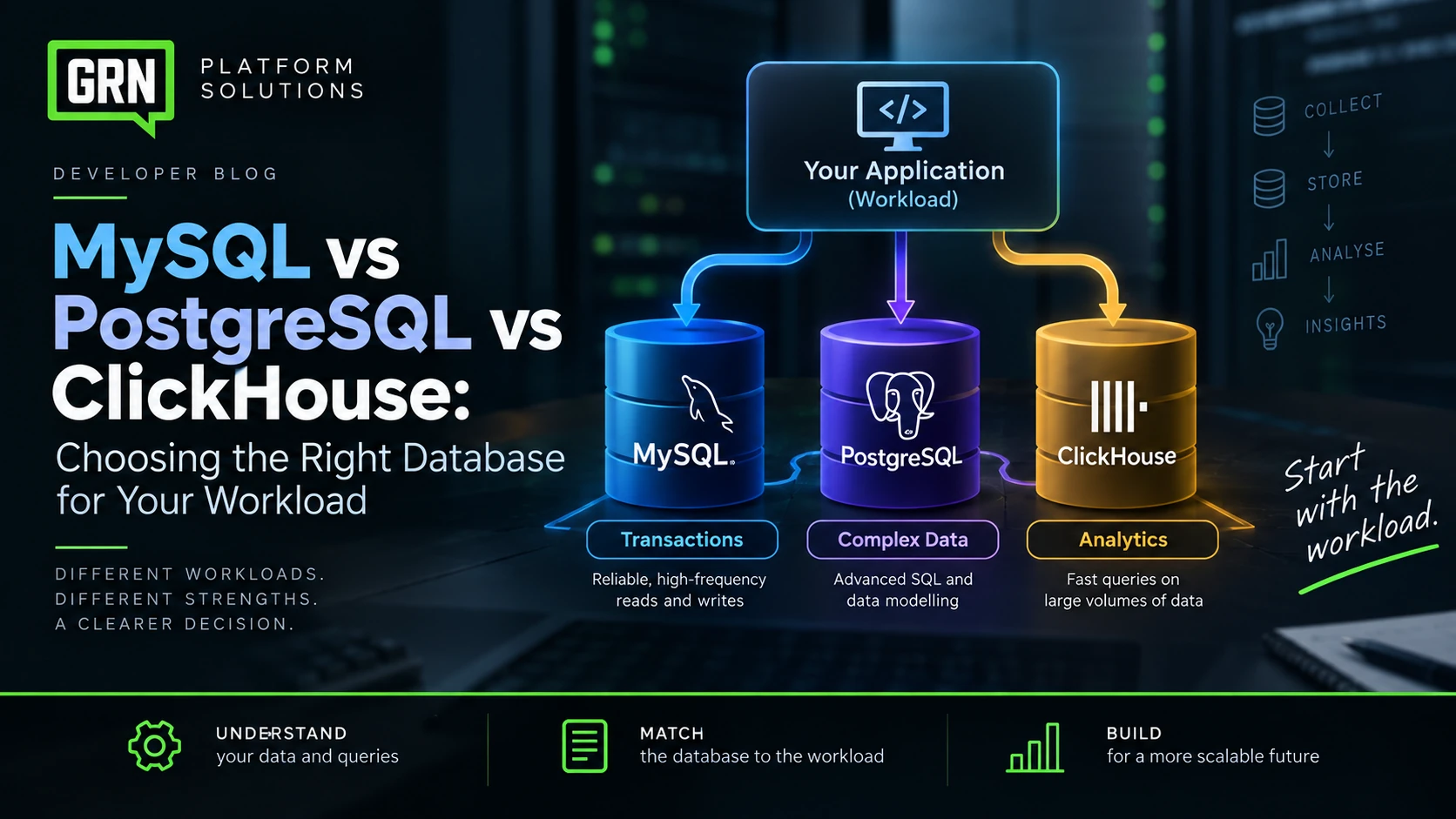
MySQL, PostgreSQL and ClickHouse are all powerful databases, but they are designed with different types of workloads in mind. MySQL and PostgreSQL are commonly used for application data and transactional workloads, while ClickHouse is designed for fast analytical queries across large volumes of data.
In this article, we’ll look at the key differences between these databases and, more importantly, understand when each one makes sense to use.
The goal is not to find a single “best” database. It is to understand how to choose the right database for the problem you are trying to solve.
OLTP vs OLAP
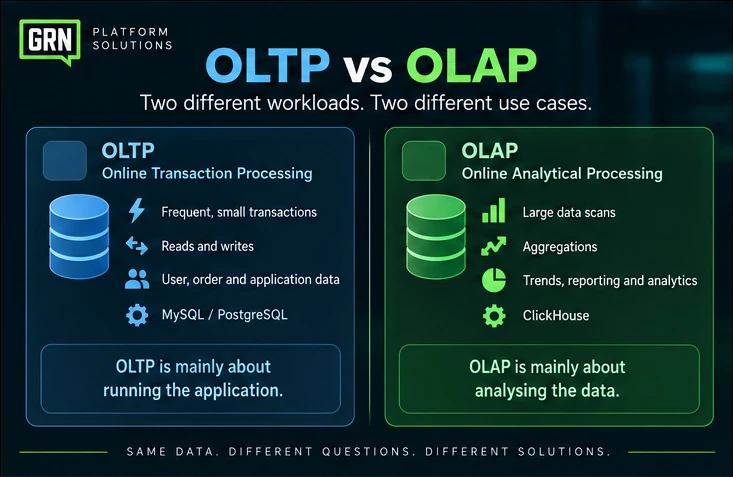
Before comparing MySQL, PostgreSQL and ClickHouse, it helps to understand two common types of database workloads: OLTP and OLAP.
OLTP — Online Transaction Processing
OLTP databases are designed for the everyday operations of an application.
They handle frequent transactions such as creating users, placing orders, updating records or processing payments.
The focus is on fast, reliable transactions and frequent reads and writes.
MySQL and PostgreSQL are commonly used for these types of workloads.
OLAP — Online Analytical Processing
OLAP databases are designed for analysing large volumes of data.
Their primary workload involves querying and aggregating data across many rows to identify patterns, trends and other insights.
For example, an analytical query might calculate totals, averages or trends across millions of historical records.
ClickHouse is designed specifically with these kinds of workloads in mind.
Put simply:
OLTP is mainly about running the application, while OLAP is mainly about analysing the data.
OLTP and OLAP solve different data problems — and often require different architectural choices.
MySQL vs PostgreSQL vs ClickHouse
MySQL
MySQL is a popular relational database commonly used for web applications and transactional workloads.
It works well when an application needs to perform day-to-day operations such as creating users, placing orders, updating records and managing application data.
MySQL is a good choice when an application primarily needs reliable transactions and straightforward application data management.
PostgreSQL
PostgreSQL is a powerful relational database with strong support for complex queries, advanced data types and sophisticated data modelling.
It is well suited to applications where the database requirements extend beyond basic transactional operations and where developers need greater flexibility in how data is structured, queried and related.
PostgreSQL is a good choice when an application needs advanced SQL capabilities, complex relationships or richer data modelling.
ClickHouse
ClickHouse is a column-oriented database designed primarily for analytical workloads.
It is particularly useful when applications need to analyse and aggregate large volumes of data for reporting, analysis, monitoring or business insights.
Unlike a typical transactional query, an analytical query may need to process millions of records to calculate totals, averages, trends and other aggregated results.
ClickHouse is a good choice when the primary workload involves analysing large amounts of data rather than frequently updating individual records.
How Do You Choose?
There is no single database that is the best choice for every application.
The right option depends on how the application uses its data and what kinds of queries it needs to perform.
If your application primarily handles transactions, CRUD operations and frequent reads and writes, MySQL or PostgreSQL will generally be a suitable starting point.
Between the two, PostgreSQL can be a particularly good fit when the application requires more complex queries, relationships or advanced data modelling.
If the main requirement is analysing large volumes of data, especially through aggregations, reporting and analytical queries, ClickHouse is a more natural fit.
This becomes especially relevant when a system needs to process large amounts of historical or event-based data rather than constantly update individual records.
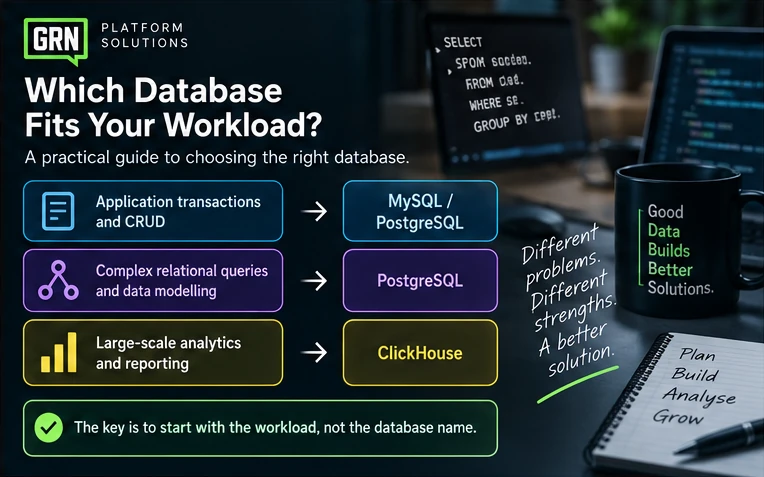
A simple way to think about it is:
Requirement
Suitable choice
Application transactions and CRUD
MySQL / PostgreSQL
Complex relational queries and data modelling
PostgreSQL
Large-scale analytics and reporting
ClickHouse
The key is to start with the workload, not the database name.
A Practical Example
Consider a manufacturing environment where a system needs to work with large amounts of production and material data.
This might include instrument readings, raw material quantities and prices, country of origin information and historical production records.
In this type of system, the data is not simply stored so individual records can be retrieved later. It also needs to be analysed to support calculations, reporting and business decisions, with processing logic working across different parts of the dataset.
In a project I worked on, ClickHouse was used to support this data-intensive analytical workload.
I integrated ClickHouse with the Laravel application, while a separate Python-based system handled the data-processing and analytical logic.
That experience highlighted an important point about database selection:
The same system can contain very different workloads, and those workloads do not necessarily need to be handled by the same database technology.
Transactional application data and large-scale analytical data have different characteristics. Trying to force both into the same architecture simply because one database is already being used elsewhere in the application can create unnecessary limitations later.
Sometimes the better architectural decision is not choosing between two databases.
It is recognising that they are solving different problems.
Conclusion
MySQL, PostgreSQL and ClickHouse are all capable databases, but each is suited to different types of workloads.
For transactional application data, MySQL and PostgreSQL are common choices, while ClickHouse is particularly well suited to large-scale analytical workloads.
The important thing is to start with the problem rather than the database.
Consider the type of data you have, how it will be accessed, the queries your application needs to run and how the workload may grow over time.
The right database is not necessarily the most powerful one — it is the one that best matches the problem you are trying to solve.
Ajay Kumar Maurya is a Software Developer at Green Platform Solutions, working across application development, data processing and backend technologies.
Ready to Transform Your Business with AI?
Get expert guidance on implementing AI solutions that actually work. Our team will help you design, build, and deploy custom automation tailored to your business needs.
We use analytics cookies to understand how the site is used. You can accept or decline —
essential functionality works either way. See our
Privacy Policy.